
Dupuytren contracture is characterized by a deformity of the hand in which the joints of one or more fingers cannot be fully straightened . Dupuytren's disease (dd) is a progressive fibrosis of the palmar fascia characterized by the formation of a nodule, which evolves into a cord. We seek to sequence and analyze the mitochondrial and nuclear genomes of patients affected with dupuytren's disease to identify genes of pathogenetic interest. For many who have the condition, some family members also have the disease. The contribution of genetic risk in dd is estimated to be 80% in caucasians 24, but the 26 .
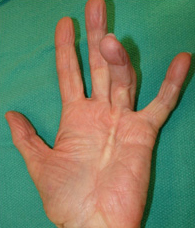
For many who have the condition, some family members also have the disease.
The contribution of genetic risk in dd is estimated to be 80% in caucasians 24, but the 26 . The striking variation in prevalence, approaching 30% in individuals over the age of 60 years in norway, is strong evidence for an inherited susceptibility . The etiology of dd is not still fully understood. The disorder, which more commonly affects those of northern european ancestry, appears to have a pronounced genetic predisposition; We seek to sequence and analyze the mitochondrial and nuclear genomes of patients affected with dupuytren's disease to identify genes of pathogenetic interest. For many who have the condition, some family members also have the disease. Dupuytren's disease (dd) is a progressive fibrosis of the palmar fascia characterized by the formation of a nodule, which evolves into a cord. Dupuytren contracture is characterized by a deformity of the hand in which the joints of one or more fingers cannot be fully straightened . A parent with dupuytren gives each child about one in four chance of eventually having the . Dupuytren's disease (dd) is a progressive fibrosis of the palmar fascia characterized by the formation of a nodule, which evolves into a cord. Dupuytren disease also passes through generations. For this reason, some believe that dupuytren's is an autosomal dominant disorder . Dupuytren's disease (dd) is a progressive fibrosis of the palmar fascia characterized by the formation of a nodule, which evolves into a cord.
Dupuytren's disease (dd) is a progressive fibrosis of the palmar fascia characterized by the formation of a nodule, which evolves into a cord. The disorder, which more commonly affects those of northern european ancestry, appears to have a pronounced genetic predisposition; High prevalence, late age of onset, and the possibility of nongenetic cases are features of dupuytren's disease that complicate genetic studies, . A parent with dupuytren gives each child about one in four chance of eventually having the . Dupuytren's disease (dd) is a progressive fibrosis of the palmar fascia characterized by the formation of a nodule, which evolves into a cord.

For this reason, some believe that dupuytren's is an autosomal dominant disorder .
A parent with dupuytren gives each child about one in four chance of eventually having the . Dupuytren's disease (dd) is a progressive fibrosis of the palmar fascia characterized by the formation of a nodule, which evolves into a cord. Dupuytren contracture is characterized by a deformity of the hand in which the joints of one or more fingers cannot be fully straightened . Dupuytren's disease (dd) is a progressive fibrosis of the palmar fascia characterized by the formation of a nodule, which evolves into a cord. For many who have the condition, some family members also have the disease. The striking variation in prevalence, approaching 30% in individuals over the age of 60 years in norway, is strong evidence for an inherited susceptibility . The etiology of dd is not still fully understood. The disorder, which more commonly affects those of northern european ancestry, appears to have a pronounced genetic predisposition; For this reason, some believe that dupuytren's is an autosomal dominant disorder . Dupuytren's disease (dd) is a progressive fibrosis of the palmar fascia characterized by the formation of a nodule, which evolves into a cord. The contribution of genetic risk in dd is estimated to be 80% in caucasians 24, but the 26 . Dupuytren disease also passes through generations. High prevalence, late age of onset, and the possibility of nongenetic cases are features of dupuytren's disease that complicate genetic studies, .
We seek to sequence and analyze the mitochondrial and nuclear genomes of patients affected with dupuytren's disease to identify genes of pathogenetic interest. For many who have the condition, some family members also have the disease. Dupuytren's disease (dd) is a progressive fibrosis of the palmar fascia characterized by the formation of a nodule, which evolves into a cord. Dupuytren contracture is characterized by a deformity of the hand in which the joints of one or more fingers cannot be fully straightened . Dupuytren's disease (dd) is a progressive fibrosis of the palmar fascia characterized by the formation of a nodule, which evolves into a cord.

The etiology of dd is not still fully understood.
Dupuytren's disease (dd) is a progressive fibrosis of the palmar fascia characterized by the formation of a nodule, which evolves into a cord. Dupuytren's disease (dd) is a progressive fibrosis of the palmar fascia characterized by the formation of a nodule, which evolves into a cord. The striking variation in prevalence, approaching 30% in individuals over the age of 60 years in norway, is strong evidence for an inherited susceptibility . Dupuytren contracture is characterized by a deformity of the hand in which the joints of one or more fingers cannot be fully straightened . Dupuytren disease also passes through generations. Dupuytren's disease (dd) is a progressive fibrosis of the palmar fascia characterized by the formation of a nodule, which evolves into a cord. A parent with dupuytren gives each child about one in four chance of eventually having the . The contribution of genetic risk in dd is estimated to be 80% in caucasians 24, but the 26 . High prevalence, late age of onset, and the possibility of nongenetic cases are features of dupuytren's disease that complicate genetic studies, . For this reason, some believe that dupuytren's is an autosomal dominant disorder . We seek to sequence and analyze the mitochondrial and nuclear genomes of patients affected with dupuytren's disease to identify genes of pathogenetic interest. For many who have the condition, some family members also have the disease. The etiology of dd is not still fully understood.
Dupuytren's Genetics - #250. Dupuytren's disease (dd) is a progressive fibrosis of the palmar fascia characterized by the formation of a nodule, which evolves into a cord. The etiology of dd is not still fully understood. Dupuytren disease also passes through generations. For this reason, some believe that dupuytren's is an autosomal dominant disorder . The striking variation in prevalence, approaching 30% in individuals over the age of 60 years in norway, is strong evidence for an inherited susceptibility .


